
The short answer
An enlarged prostate rarely announces itself. The early signs are small: going a little more often, waiting a second for the stream to start, one trip at night. Men explain each one away for years. Recognising the pattern early is what keeps a manageable condition from becoming a serious one.
Before you read on
Some links on this page are affiliate links, including the ones to FlowForce Max. If you buy through one, I earn a commission at no extra cost to you. It never changes what I write here.
Nobody in my family remembers the day my father-in-law's prostate became a problem. That's the point. There wasn't one.
There was a year he started going to the bathroom before every car trip. A year he began sleeping in the guest room. A year he stopped drinking anything after dinner. Each change had an explanation. None of the explanations was "prostate."
By the time a doctor said the word out loud, he'd been living with an enlarged prostate for the better part of a decade. This article is the list I wish someone had handed him in year one.
What is an enlarged prostate, and why doesn't it hurt?
The prostate is a small gland below the bladder. The urethra, the tube that carries urine out, runs straight through the middle of it. From around 40, the gland slowly starts to grow again. The medical name is benign prostatic hyperplasia, or BPH.
"Benign" is the important word. This is not cancer. It's ordinary, age-related growth, and it's remarkably common. The NIDDK calls it the most common prostate problem in men older than 50.
The reason it goes unnoticed is that it doesn't hurt. A growing prostate doesn't send pain signals. It squeezes the urethra a little more each year, and the only evidence is a slow change in how you urinate. Slow enough that you adjust to each step without noticing you've adjusted.
Share of men over the age of 80 who have an enlarged prostate, according to the U.S. National Library of Medicine. A small amount of enlargement is already present in many men over 40. Source: "Enlarged prostate," MedlinePlus Medical Encyclopedia, National Institutes of Health
Read that number the way I eventually did. It doesn't mean "this is normal, ignore it." It means almost every man will face this, and the ones who do best are the ones who name it early.
What are the 7 early signs of an enlarged prostate?
These are the classic symptoms that the NIDDK and MedlinePlus list for BPH, in the order most men tend to notice them. The catch is that none of them feels like a symptom at the time. Each one feels like a habit.
1. You've started planning your day around bathrooms
This is usually the first one, and almost nobody counts it as a symptom. You go before you leave the house. You know where the restroom is in every store. You choose the aisle seat.
Urinary frequency, going eight or more times in 24 hours, is on every official list of BPH symptoms. It creeps in because a bladder that never fully empties refills faster. You're not making more urine. You're storing less of it.
2. The stream takes a moment to start
You're standing there, ready, and nothing happens for a second or two. Doctors call it hesitancy. It's the urethra needing more pressure to open than it used to, because the gland around it has narrowed the channel.
Most men notice this first in public restrooms, where a delay feels awkward, and put it down to nerves. At home, in private, they stop noticing it at all.
3. It's weaker than it was, and you've stopped comparing
A weak or interrupted stream is the sign men are least likely to mention and most likely to have. It changes so gradually that there's never a day it "got worse." There's only the vague sense that it used to be different.
My father-in-law's stream changed years before he told anyone. I wrote a separate article on what a weak urine stream after 50 actually means, including the simple flow test that turns "it feels weaker" into a number a doctor can track.
4. Dribbling after you think you're finished
You've zipped up, and there's more. A few drops, sometimes enough to matter. This is terminal dribbling, and it happens because the narrowed urethra holds back a small amount of urine that only releases once the pressure drops.
Men handle this one with toilet paper and silence. It's one of the earliest signs that the bladder is no longer emptying cleanly.
5. You never feel quite empty
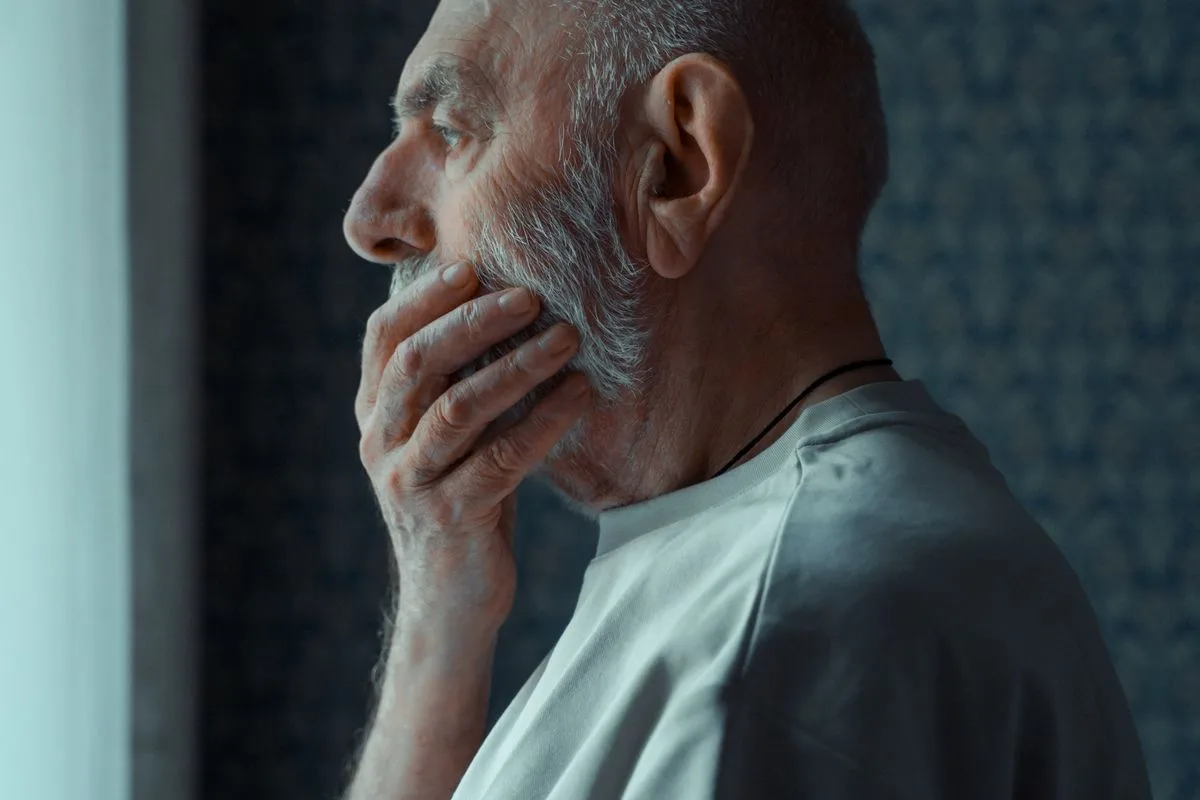
You go, and you could go again. The bladder isn't finishing the job, because it's pushing against resistance and gives up before it's done. The NIDDK lists "trouble starting a urine stream or emptying your bladder" as a core symptom for this reason.
That leftover urine is the engine behind sign number one. Start each cycle a third full, and you reach "full" a third sooner.
6. You've started waking at night to go
Once a night is common after 50 and often shrugged off. Twice is where doctors start using the word nocturia. MedlinePlus puts "needing to urinate 2 or more times per night" on its symptom list for exactly this reason.
This is the sign that finally gets most men's attention, because it takes their sleep. It's also the subject of the main guide on this site, waking up three times a night to pee after 50, which covers what you can change tonight without a prescription.
7. When you need to go, you need to go now
Urgency is the sudden, hard-to-postpone need that arrives without warning. An irritated, overworked bladder starts sending the signal earlier and louder. Some men first notice it as a near miss on the way home from somewhere.
Urgency on its own can also point to overactive bladder, a different condition with a different treatment. That's a reason to get checked rather than to guess.
If you recognise the early signs and want to do something this week
The best thing you can do this week is book the appointment. If you also want a prostate supplement while you wait, the one I researched most closely for my father-in-law is FlowForce Max, a chewable built around ingredients that keep appearing in the prostate research: saw palmetto, rye flower pollen extract, nettle root, grape seed extract and zinc.
See the official FlowForce Max page →
If you buy through this link I receive a commission at no additional cost to you.
Why do men ignore these signs for so long?
I've thought about this a lot, because I watched it happen from the next room. Three things kept my father-in-law quiet for years, and I've heard the same three from other families since.
Each sign has a plausible excuse. Frequency is the coffee. Hesitancy is the cold restroom. Night trips are the glass of water at dinner. Individually, every excuse holds. It's only the pattern, all seven together, that points somewhere.
Nothing hurts. Men are trained to treat pain as the signal for a doctor. BPH doesn't provide one. A condition that's merely inconvenient gets filed under "getting older" instead of "get checked."
The fear underneath. The word "prostate" makes men think of one thing, and it isn't BPH. The fear of hearing "cancer" keeps men away from the one appointment that would tell them, in most cases, that it isn't. I cover the honest answer to that fear in the weak stream article.
He had a good reason for every single symptom. What he didn't have was anyone adding them up.
Which signs are not early at all, but urgent?
The seven signs above are the mild, early stage. A few symptoms belong in a different category, and the NIDDK says to tell a health care professional right away if any of them appear:
- You cannot urinate at all while your bladder feels full. This is acute urinary retention. It's an emergency, and it means the same day, not the next appointment.
- Blood in your urine. Usually explained by something minor, but never something to wait on.
- Fever and chills alongside painful, frequent, urgent urination. That points to an infection that has taken hold.
- Great discomfort or pain in your lower abdomen or urinary tract.
If you're reading this list and recognising the first item, stop reading and go. Everything else on this page can wait. Retention can't.
What does catching it early actually change?
This is the question that matters, because "see a doctor" only lands if there's a reason. Here's the reason.
BPH tends to progress. A bladder forced to push against a blockage for years thickens and loses elasticity. It gets worse at emptying and worse at holding. That's the road to retention, catheters and, eventually, the leaking that ends in adult diapers. I described that road in how prostate problems progress when they're ignored, because my family walked it.
Early diagnosis interrupts the road. That's not a hope. It has been measured.
Lower risk of clinical BPH progression over 4.5 years among men on long-term combination therapy, compared with placebo, in a trial of 3,047 men. Progression meant a meaningful rise in symptom score, acute urinary retention, incontinence, kidney impairment or recurrent infection. Source: McConnell et al., "The long-term effect of doxazosin, finasteride, and combination therapy on the clinical progression of benign prostatic hyperplasia," New England Journal of Medicine, 2003
You can only be in a trial like that, or on a treatment like that, if someone has named the condition. Men who wait until retention have skipped the stage where the gentlest options work best.
Early also means more choices. Mild BPH is often managed with monitoring and a few habit changes. Moderate BPH usually responds to medication. Severe BPH may need a procedure. Every year of "wait and see" shifts you one column to the right.
What should you do this week if you recognise yourself?
Not a crash programme. Three specific things, in order.
Keep a three-day log
Write down every time you urinate, day and night, for three days. Note anything that stands out: a slow start, dribbling, a sudden urge. Three days is enough to see a pattern, and it's the single most useful thing you can carry into a doctor's office.
Score yourself honestly
Urologists use a seven-question sheet called the International Prostate Symptom Score. It asks how often, over the last month, you've had incomplete emptying, frequency, stopping and starting, urgency, a weak stream, straining and night trips. Each answer is scored 0 to 5. The total runs from 0 to 35: roughly 0 to 7 is mild, 8 to 19 moderate, 20 and above severe.
You'll see the same questions on your first visit. Answering them at home first takes the surprise out of the number. Most men score higher than they expected, because the questions ask about things they'd stopped noticing.
Book the appointment
The first visit is short and undramatic: the questionnaire, a urine sample, usually a PSA blood test, and a brief physical exam. Around fifteen minutes. The main guide has a full section on when to see a urologist and what happens there.
If the idea of the appointment is the obstacle, tell someone. My father-in-law finally went because my mother-in-law booked it and drove. There's no rule that says you have to do this part alone.
Could the early signs be something other than the prostate?
Yes, and a doctor will check. Type 2 diabetes causes frequency. Some blood pressure medicines schedule your night trips. Overactive bladder produces urgency without any blockage. Antihistamines and decongestants can make a borderline stream noticeably worse.
In men over 50, BPH is the most likely explanation for the seven signs above. It's still not the only one, and that's the strongest argument against diagnosing yourself. The signs get you to the appointment. The appointment tells you what they mean.
A supplement while you wait for the appointment
Book the urologist first. If you also want a prostate formula in the meantime, FlowForce Max is the one I researched most closely for my own family: saw palmetto, rye flower pollen, nettle root and zinc in a chewable form. The review covers what's in it, what it costs and who it fits.
Affiliate link. I earn a commission at no extra cost to you. Not medical advice, and not a replacement for seeing a doctor.
Frequently asked questions
What is usually the first sign of an enlarged prostate?
For most men it's a change in frequency: going more often during the day, then starting to wake at night. It's rarely dramatic. The stream is usually still fine at this stage, which is why so many men put it down to age, coffee, or "a small bladder."
At what age does an enlarged prostate usually start?
The gland starts growing again in most men after 40, and symptoms typically become noticeable in the 50s. The NIDDK reports BPH in 5 to 6 percent of men aged 40 to 64 and 29 to 33 percent of men 65 and older. MedlinePlus notes that more than 90 percent of men over 80 have the condition.
Can an enlarged prostate be caught early?
Yes. The early signs are ordinary and easy to dismiss, but a urologist can confirm BPH with a symptom questionnaire, a urine test, a PSA blood test and a brief exam. Catching it while symptoms are mild widens the range of treatments and, according to long-term trials, lowers the risk of complications such as urinary retention.
Do the early signs of an enlarged prostate mean cancer?
Usually not. The seven signs in this article are the classic pattern of benign prostatic hyperplasia, which is not cancer. Early prostate cancer typically causes no symptoms at all. The two can overlap, though, so a PSA test and an exam are the only way to settle the question.
Which prostate symptoms should never be ignored?
Being unable to urinate at all while your bladder feels full, blood in the urine, fever and chills alongside urinary symptoms, or pain in the lower abdomen or urinary tract. The NIDDK lists all four as reasons to tell a health care professional right away rather than waiting for a routine appointment.

Why I write about this
Carla S.
I'm not a doctor and I won't pretend to be. I write about prostate health because I watched my father-in-law live through it: first the small signs everyone explained away, then the nights, then the years of leaking that ended with adult diapers as part of his daily routine.
I helped care for him through that, read everything I could find, and sat in on the appointments. That's the experience behind this site. More about why I started it.
Medical disclaimer: I am not a physician, nurse, or licensed health professional. Nothing here is medical advice or a diagnosis. Always consult a doctor or urologist about your own symptoms.